
Category: Insurance

  • Why You Should Call Your Insurance Agent Before Filing a Claim

    Insurance is designed to protect you when something goes wrong. However, not every small repair or minor loss should automatically become an insurance claim.

    Before filing a non-emergency home or auto claim, speak with your insurance agent. A short conversation can help you understand your deductible, review the estimated repair cost, and consider how the claim could affect your insurance history.

    A Claim Can Become Part of Your Insurance History

    Many people assume a claim only matters when the insurance company pays for the damage. However, once a loss is reported, it may become part of your claims history—even when the claim closes without payment.

    Insurance companies may review previous claims when setting rates, deciding whether to offer coverage, renewing a policy, or determining eligibility for certain discounts.

    One claim does not automatically mean your premium will increase or your policy will be canceled. However, several claims within a short period may affect your future insurance options.

    Small Claims Deserve Careful Consideration

    Imagine that a homeowner discovers water damage under a kitchen sink. Repairs are estimated at $1,500, and the policy has a $1,000 deductible.

    Even if the damage is covered, the potential payment may only be around $500. The homeowner must decide whether that payment is worth adding a claim to their insurance history.

    Before filing, consider:

    • The estimated repair cost
    • Your deductible
    • The cause of the damage
    • Whether additional damage may exist
    • Your recent claims history

    Your agent can help you review these details, although the insurance company’s claims department makes the final coverage decision.

    A Brief Note About C.L.U.E. Reports

    Home and auto claims may appear in an insurance-history database commonly called C.L.U.E. Insurance companies may review this information when pricing a policy or deciding whether to offer coverage.

    This Does Not Mean You Should Avoid Legitimate Claims

    Insurance exists to protect you from covered losses. You should not be afraid to use your policy when you experience serious damage, injuries, liability, or expenses that would be difficult to handle on your own.

    A large fire, major water loss, serious collision, theft, or liability incident is very different from a repair that costs only slightly more than the deductible.

    The goal is not to discourage claims. The goal is to help customers understand that reporting a claim can have consequences beyond the immediate payment.

    Filing should be a deliberate and informed decision.

    Be Clear When Asking a Question

    When contacting your agent, explain that you are asking for guidance and are not yet requesting that a claim be filed.

    You might say:

    “I have a question about my coverage, but I am not asking to file a claim at this time.”

    Your agent can help you understand your deductible, review your coverage, and discuss possible next steps. They cannot guarantee that a loss will be covered, but they can help you make a better-informed decision.

    Call Tommy Thomsen Insurance Before You File

    At Tommy Thomsen Insurance, we help customers understand their policies and options before making an important claims decision.

    Before filing a smaller, non-emergency home or auto claim, call us at 801-982-7200.

    A quick conversation may help you protect both your finances today and your insurance options in the future.

    This article provides general information and is not a guarantee of coverage, claim payment, renewal, or premium changes. Decisions depend on the policy, circumstances of the loss, claims investigation, and insurance company guidelines.


  • Employee or Independent Contractor? What Utah Businesses Need to Know

    Hiring someone as an independent contractor can give a business flexibility. However, simply calling a worker a contractor—or paying them with a 1099—does not automatically make them one.

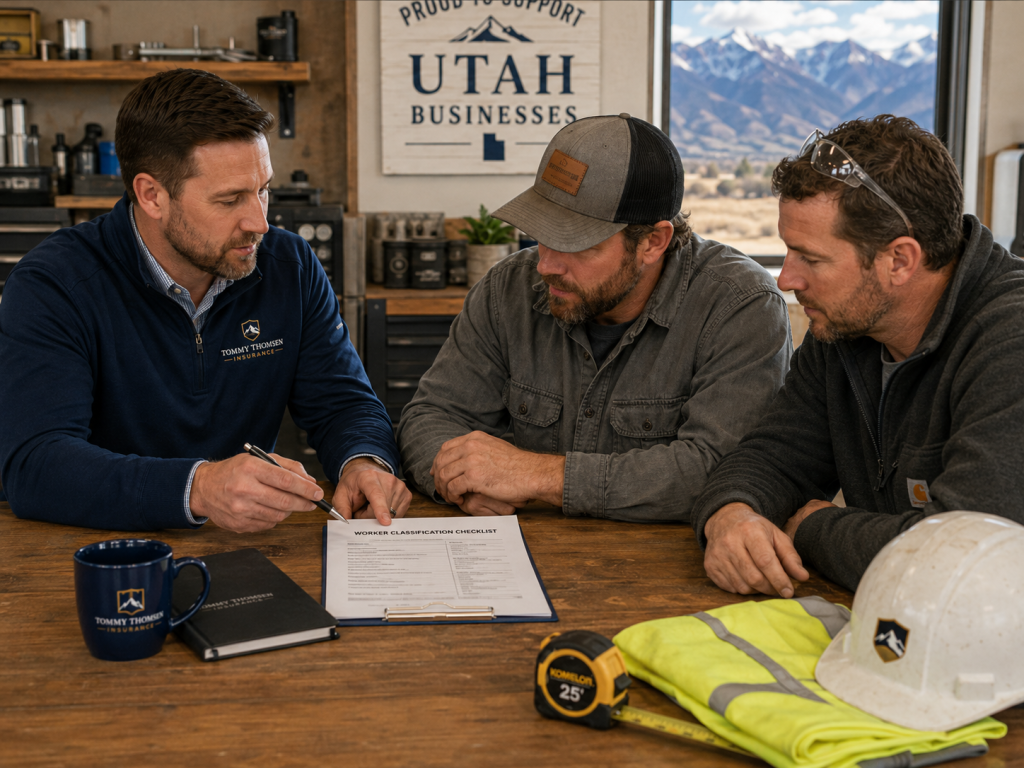
    Consider a Utah contractor who hires someone to help on several jobs. The worker is called a 1099 contractor, but the business sets his schedule, tells him how to complete each task, provides his tools, and pays him by the hour.

    If that worker is injured, the business may discover that he was actually functioning more like an employee.

    That distinction matters because misclassified workers can lose access to protections such as workers’ compensation, while the business may face claims, penalties, unpaid premiums, and other financial consequences

    A 1099 Form Does Not Decide Worker Status

    Utah workers’ compensation law focuses on the actual working relationship, not simply the title used in an agreement or the tax form issued at the end of the year.

    Under Utah law, an independent contractor generally must:

    • Remain independent in how the work is completed.
    • Not be subject to the hiring company’s routine control.
    • Be hired for a definite job or specific piece of work.
    • Be responsible for producing the agreed-upon result.

    The more control a business has over how, when, and where someone works, the more likely that person may be considered an employee.

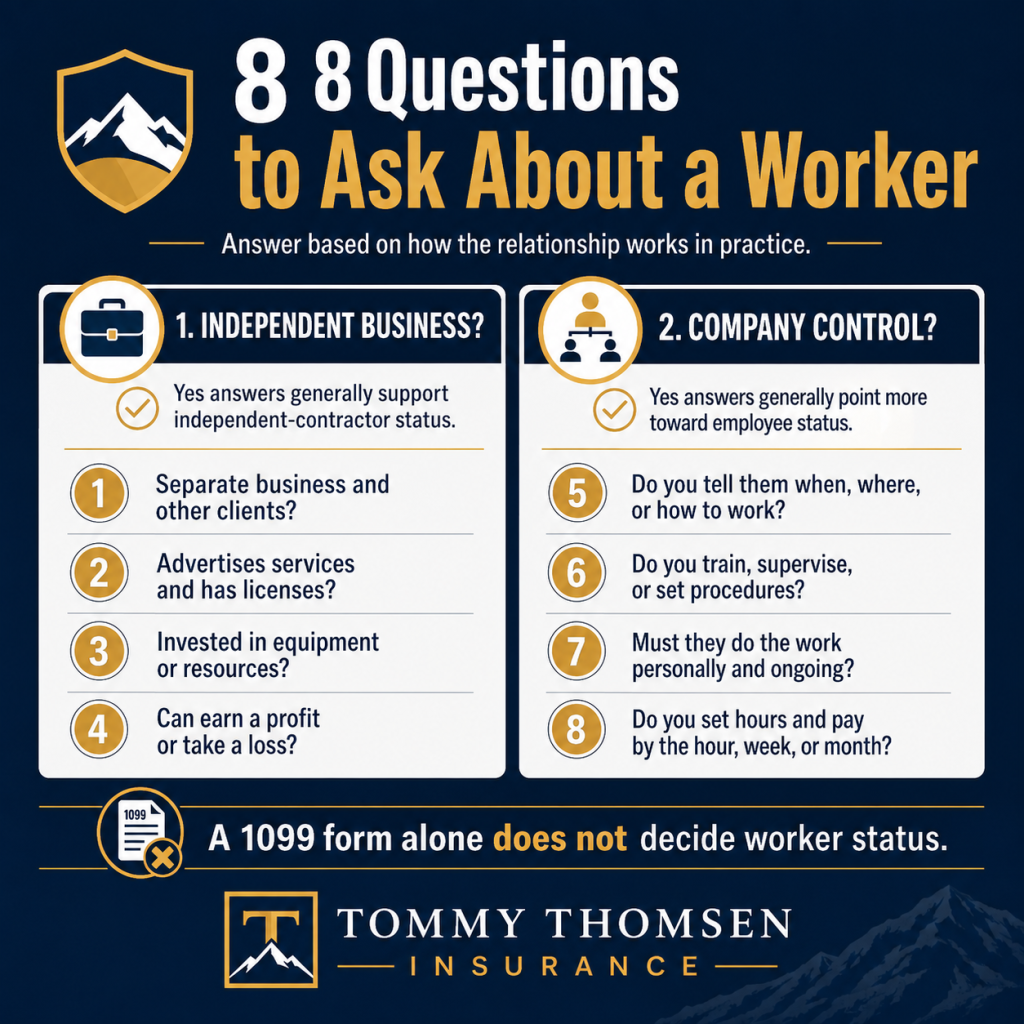
    8 Questions to Ask About a Worker

    The following simplified questions can help identify if a worker would be classified as an independent contractor or an employee.

    Answer each question based on how the working relationship operates in practice—not only what the contract or tax form says.

    Does the Worker Operate an Independent Business?

    A Yes answer generally supports independent-contractor status.

    1. Does the worker operate a separate business and offer similar services to other customers?
    2. Does the worker advertise their services and hold any required business, trade, or professional licenses?
    3. Has the worker invested in the equipment, facilities, or resources needed to operate their business?
    4. Can the worker make a profit or experience a financial loss based on their own pricing, expenses, and business decisions?

    Does Your Company Control the Worker?

    A Yes answer generally points more toward employee status.

    1. Do you tell the worker when, where, or how the work must be performed?
    2. Do you train, supervise, or require the worker to follow your company’s specific procedures, pace, or sequence?
    3. Must the worker personally perform the services, and is the relationship ongoing rather than limited to a specific project?
    4. Do you set the worker’s hours and pay them regularly by the hour, week, or month?

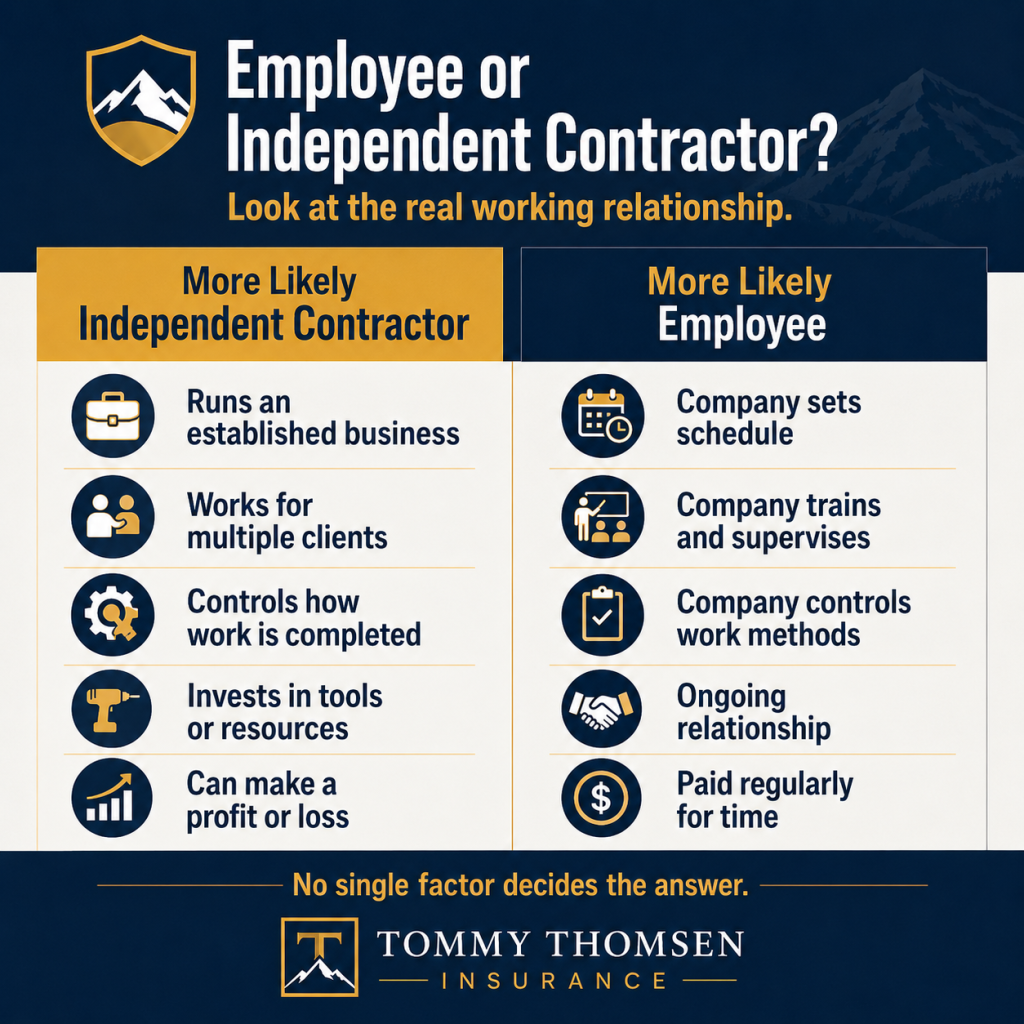
    Understanding the Results

    A worker is more likely to be an independent contractor when they:

    • Operate an established business
    • Serve multiple customers
    • Advertise their services
    • Control how the work is completed
    • Invest in their own business
    • Have an opportunity for profit or loss

    A worker is more likely to be an employee when the company:

    • Sets their schedule
    • Trains and supervises them
    • Controls their work methods
    • Requires personal service
    • Maintains an ongoing relationship
    • Pays them regularly for their time

    A 1099 form or independent-contractor agreement does not determine employment status by itself. Under the Utah guidelines, the worker generally must operate an independently established business and remain free from the company’s control over how the services are performed.

    This checklist is a general screening tool and does not provide a final legal determination. The importance of each factor may vary depending on the occupation and facts of the working relationship.

  • Workers’ Compensation Insurance for Utah Businesses | Tommy Thomsen Insurance

    Running a business comes with risks, but few are as serious as someone getting hurt while working for you. Workers’ compensation helps protect your employees, contractors, business, and everything you have worked hard to build.

    A 1099 Form May Not Protect Your Business

    Imagine that a Utah contractor hires a 1099 worker to help complete a construction project. The worker brings a helper to the jobsite.

    While carrying materials down a ladder, the helper falls and suffers a serious injury.

    The contractor believed everyone was covered because the worker received a 1099 instead of a W-2. However, no one verified whether the worker had workers’ compensation insurance or a valid Utah workers’ compensation coverage waiver.

    Suddenly, the businesses involved may be facing medical expenses, lost wages, legal questions, and significant financial exposure.

    A tax form does not make these responsibilities disappear.

    Construction Helpers Can Create Additional Exposure

    This is especially important in construction.

    A self-employed contractor may qualify for a waiver when working alone. However, when that contractor brings helpers onto the job, those helpers may be considered the contractor’s employees. Because a Utah coverage waiver is intended for a business with no employees, bringing helpers can change the contractor’s coverage responsibilities.

    Utah expects a business hiring a contractor to verify that the contractor has complied with workers’ compensation requirements. If the contractor is uninsured and has employees, the hiring business may be treated as the workers’ statutory employer and could become responsible for workers’ compensation benefits.

    Utah Coverage Can Begin With One Worker

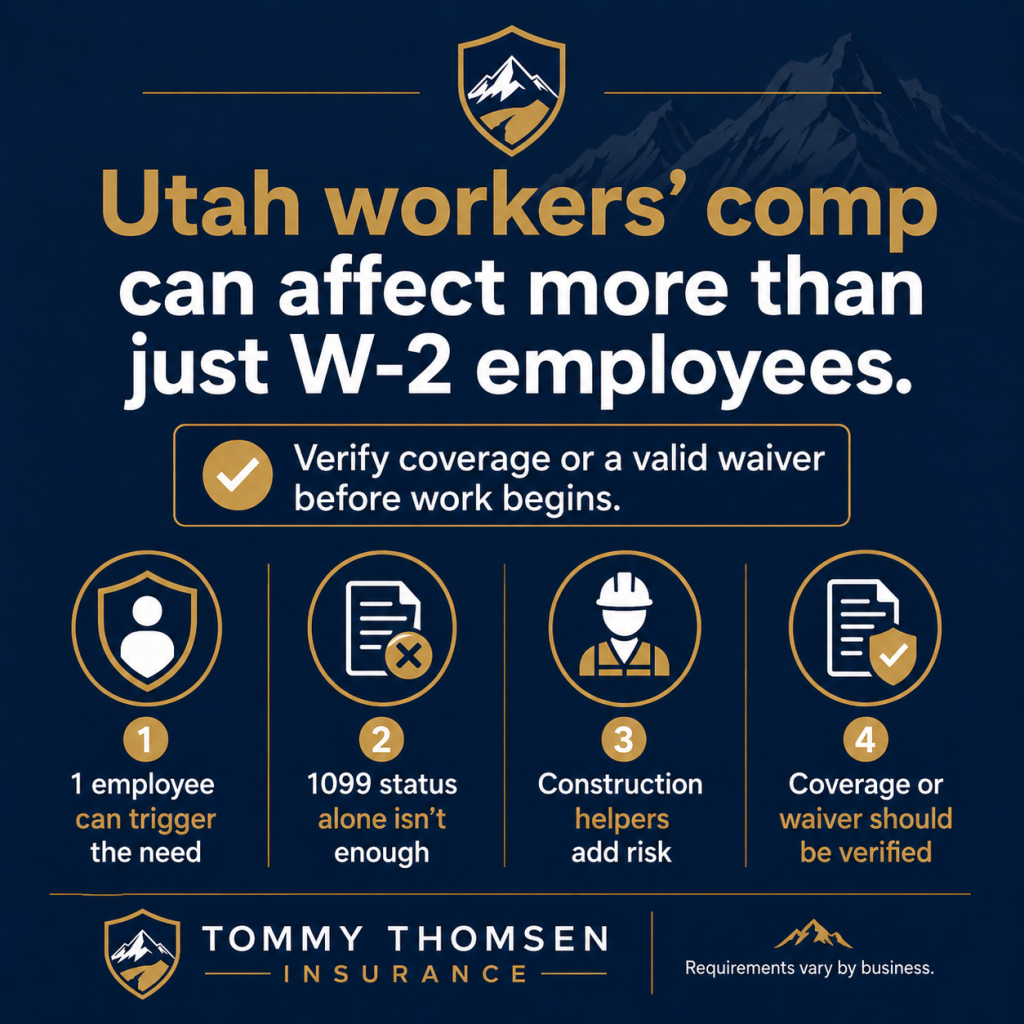
    In Utah, most businesses must carry workers’ compensation insurance when they have even one employee, including part-time employees. Coverage generally begins as soon as the employee starts working.

    Businesses also need to be careful when hiring 1099 workers and subcontractors. To qualify as an independent contractor, the worker must actually operate independently, remain free from routine control, and be hired to complete a definite job or piece of work. Simply calling someone an independent contractor or issuing a 1099 does not settle the question.

    A genuine independent contractor who has no employees may qualify for a Workers’ Compensation Coverage Waiver from the Utah Labor Commission. The waiver confirms that the contractor has no employees and has provided evidence of being an independently established business.

    Before work begins, business owners should verify that every contractor provides either:

    • Proof of active workers’ compensation coverage, or
    • A valid Utah workers’ compensation coverage waiver.

    Workers’ Compensation Protects Both Sides

    For a covered workplace injury, workers’ compensation may help provide:

    • Necessary medical treatment
    • Partial replacement of lost wages
    • Disability benefits
    • Protection for the employer through the workers’ compensation system

    Without required coverage, a business may face penalties, interruption of business operations, and the loss of protections that normally limit workplace injury lawsuits.

    Workers’ compensation is not only about following the law. It is about making sure an injured worker receives help while protecting the financial future of the business.

    Protect Everyone Working for Your Business

    Whether someone receives a W-2 or a 1099, do not assume your business is protected.

    Verify workers’ compensation coverage, collect valid waivers when appropriate, and make sure subcontractors who use helpers have the proper protection in place.

    At Tommy Thomsen Insurance, we help Utah business owners understand their workers’ compensation options and identify potential coverage gaps before an accident happens.

    Request a Workers’ Compensation Quote

    Protect your employees, contractors, and business.

    Request a quote through our website or call Tommy Thomsen Insurance at 801-982-7200. We will learn about your business, answer your questions, and help you find the right coverage.

    This article provides general information and is not legal advice. Worker classification and workers’ compensation requirements depend on the facts of each working relationship. Consult a qualified insurance or legal professional regarding your specific business.